
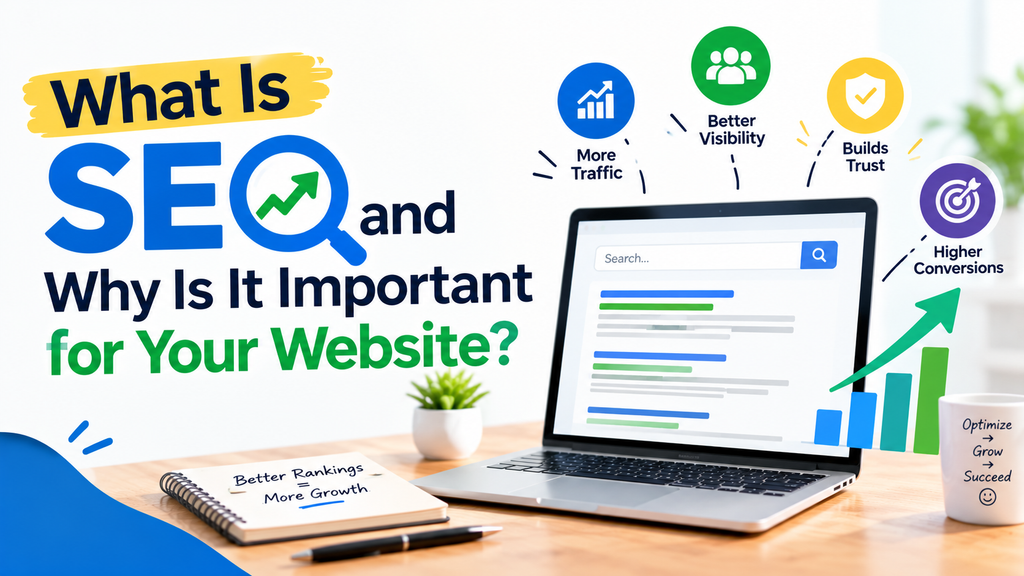
SEO helps improve your website so that search engines can better understand your content. As a result, people can find your website more easily. Furthermore, it is one of the most useful ways to attract visitors who are already interested in what you offer.
In this blog, we will explain in simple English. In addition, we will explore its main types and share practical tips to help you get started.
You can also read this detailed guide from Semrush to learn more about website optimization.
What Is search engine optimizing ?
it stands for Search Engine Optimization. It is the process of improving a website to help it appear more prominently in unpaid search results on search engines such as Google.
For example, imagine you offer WordPress website design services. Someone searches for “how to build a WordPress website.” If you have a helpful article on that topic and your website is well optimized, your page may appear in the search results.
However, it does not guarantee the first position on Google. Instead, it helps search engines understand your pages and allows users to find useful information.
Therefore, the main goal of seo is to attract the right visitors and give them a good experience.
Importants of seo
it can help your website grow in several ways. For example, it can increase website traffic, improve visibility, and attract potential customers.
1. Get More Website Visitors
When your website appears in relevant search results, more people may visit it. As a result, these visitors can become readers, potential customers, or clients.
2. Build Trust
People often trust websites that provide useful answers to their questions. Therefore, creating clear and helpful content can build confidence in your business.
3. Reach the Right Audience
it helps you connect with people who are already searching for information, products, or services related to your business. In other words, it helps you reach people who are interested in what you offer.
4. Support Long-Term Growth
Paid advertisements can bring visitors while a campaign is running. However, SEO can continue attracting visitors over time, although rankings and traffic can change.
5. Improve Your Website
Good SEO also encourages you to improve your website structure, loading speed, mobile experience, and content quality. Furthermore, these improvements make your website easier to use.
What Are the Main Types
SEO includes several important areas. Therefore, understanding these types can help you build a better SEO strategy.
1. On-Page SEO
On-page SEO means improving the content and elements on your website pages.
For example, some important on-page SEO practices include:
- Using relevant keywords naturally.
- Writing clear and useful headings.
- Creating descriptive page titles.
- Adding helpful meta descriptions.
- Using descriptive image alt text.
- Linking to other relevant pages on your website.
For instance, if your article is about WordPress website design, your title, headings, and content should clearly explain that topic. However, avoid repeating the same keyword unnecessarily.
2. Off-Page SEO
Off-page SEO includes activities outside your website that can help build its reputation and authority.
For example, one important activity is earning backlinks from other relevant and trustworthy websites. A backlink is simply a link from another website to yours.
Furthermore, you can work toward earning backlinks by publishing useful guides, creating original resources, and building relationships with people in your industry.
However, avoid buying spammy links or using tricks designed to manipulate search rankings.
3. Technical SEO
Technical SEO helps search engines discover, crawl, and understand your website.
For example, it may include improving website speed, making pages mobile-friendly, creating an XML sitemap, fixing broken links, and checking that important pages can be indexed.
If you use WordPress, plugins and website tools can help with some tasks. However, they do not automatically fix every technical problem.
4. Local SEO
Local SEO helps businesses become more visible in searches related to a particular location.
For example, a person might search for “web designer in Lahore” or “coffee shop near me.”
Therefore, businesses serving local customers can improve their local presence by keeping their business information accurate, collecting genuine customer reviews, and creating useful location-related content.
How to Improve SEO on Your Website
You do not need to be an expert to begin learning SEO. Instead, you can start with these simple steps.
Step 1: Find the Right Keywords
Keywords are the words and phrases people type into search engines.
First, think about what your target audience wants to know. For example, if you offer website design services, relevant topics might include “WordPress website design,” “Elementor website tutorial,” or “how to improve website speed.”
After that, choose keywords that match the purpose of your page and the needs of your audience.
Step 2: Write Helpful Content
Do not write articles only to include keywords. Instead, focus on answering real questions and solving problems.
For example, use simple language, short paragraphs, clear headings, and examples that readers can understand.
As a result, helpful content gives people a reason to stay on your website and learn more.
Step 3: Optimize Your Page Titles
Your page title should clearly explain what the page is about.
For example, instead of using a vague title such as “Our Tips,” use something more descriptive, such as “10 Simple SEO Tips for WordPress Websites.”
In addition, keep titles natural and relevant to the actual content.
Step 4: Improve Website Speed
A slow website can frustrate visitors. Therefore, compress large images, remove unnecessary plugins, choose reliable hosting, and use caching where appropriate.
Furthermore, check your website on both desktop and mobile devices to make sure it works smoothly.
Step 5: Add Internal Links
Internal links connect one page of your website to another.
For example, in an article about SEO, you can link to another useful article about WordPress website design.
As a result, these links help visitors discover related content and allow search engines to understand the relationship between your pages.
Step 6: Make Your Website Mobile-Friendly
Many people browse the internet using smartphones. Therefore, your website should display properly on smaller screens.
For example, use readable text, easy navigation, and buttons that are simple to tap. In this way, visitors can use your website more comfortably.
Step 7: Track Your Progress
Tools such as Google Search Console can help you understand how your website performs in Google Search.
For instance, you can review search queries, impressions, clicks, and indexing issues. After that, use this information to identify opportunities to improve your pages.
However, remember that SEO usually takes time. Results depend on your competition, website quality, industry, and many other factors.
Common SEO Mistakes You Should Avoid
Although SEO can help your website grow, some common mistakes can affect your progress. Therefore, here are some mistakes you should avoid:
- Keyword stuffing: Repeating the same keyword too many times makes content difficult to read. Instead, use keywords naturally.
- Copying content: Publishing copied material does not provide much value to readers. Therefore, create original and helpful content.
- Ignoring mobile users: A website that works poorly on phones can create a frustrating experience. Make sure your website is mobile-friendly.
- Using misleading titles: Your page title should accurately describe the content. Otherwise, visitors may leave your website.
- Ignoring technical issues: Broken pages and indexing problems can prevent important content from appearing in search results. Therefore, check your website regularly.
- Expecting instant results: SEO is an ongoing process, not a quick fix. As a result, you should focus on continuous improvements.
Is SEO Good for Small Businesses?
Yes, SEO can be valuable for small businesses that want to build an online presence.
For example, a local shop can improve its business profile and create useful pages about its products and services. Similarly, a small digital marketing agency can publish helpful articles to attract potential clients.
Furthermore, SEO https://searchengineland.com/library/seogives small businesses an opportunity to compete online without relying entirely on paid advertisements.
You do not need to do everything at once. Instead, start with small improvements and gradually develop your SEO strategy.
Conclusion
SEO is not just about getting a higher position on Google. More importantly, it is about making your website easier to find, understand, and use.
Therefore, start with small improvements and keep learning as you go. In addition, focus on creating useful content, improving website performance, and understanding your audience.
Remember: Create content for people first, and optimize it to help search engines understand it.
Finally, if you found this guide useful, share it with someone who wants to improve their website’s visibility online.
Frequently Asked Questions (FAQs)
What is SEO?
SEO stands for Search Engine Optimization. It is the process of improving a website’s visibility in unpaid search engine results.
Why is SEO important for websites?
SEO helps websites attract organic traffic, improve online visibility, build trust, and reach potential customers. As a result, businesses can grow their online presence.
What are the main types of SEO?
The four main types are On-Page SEO, Off-Page SEO, Technical SEO, and Local SEO. Each type focuses on a different part of website optimization.
How does SEO help small businesses?
SEO helps small businesses reach potential customers, promote their services, and build an online presence. Furthermore, it provides opportunities to attract visitors without paying for every click.
How long does SEO take to show results?
SEO usually takes time. However, the results depend on competition, website quality, content, and the SEO strategy you follow.
Digital marketing helps businesses reach a wider audience, build brand awareness, connect with customers, increase sales, and compete in the online marketplace.
The main types include Search Engine Optimization (SEO), social media marketing, content marketing, email marketing, pay-per-click advertising (PPC), and affiliate marketing.
It helps small businesses reach potential customers, promote their services, build an online presence, and compete with larger companies through targeted marketing strategies.
SEO improves a website’s visibility in search engine results. It helps businesses attract relevant visitors and increase organic website traffic.
Social media marketing helps businesses connect with their audience, share useful content, promote products and services, and build customer relationships.
Yes. Digital marketing offers different budget options and allows businesses to target specific audiences and measure campaign performance.
A business can start by creating a professional website, identifying its target audience, choosing suitable marketing platforms, developing quality content, and using SEO and social media strategies.